
Shipping costs eat into margins across every manufacturing sector. Freight charges climb year after year, dimensional weight pricing penalises inefficient packaging, and damage-related expenses pile up in the background. For industries such as aerospace components, industrial equipment, electronics or medical devices, packaging decisions directly affect the bottom line.
Custom packaging design companies approach this differently than suppliers pushing standard boxes. Instead of making products fit available packaging formats, they build packaging around actual product dimensions, shipping methods and cost reduction targets.
This leads to savings across many areas – lower carrier charges, reduced damage claims, less wasted material and fewer returns. For companies seeking to control their shipping expenses, it is worth understanding where standard packaging inflates cost, and likewise, how bespoke packaging solutions can address those problems.
Logistics expenses don't just cover the carrier's invoice. Packaging weight, dimensions and protection performance all feed into total shipping costs. Oversized boxes trigger dimensional weight charges. Excess material adds pounds that multiply across every shipment. Poor protection leads to damaged goods, replacement shipments and disposal costs.
Many businesses accept these expenses as unavoidable. They're not. Bespoke packaging suppliers in the UK work backwards from shipping costs to identify exactly where standard packaging creates unnecessary expenses. A box that's three inches too large in each dimension might not seem significant until you calculate dimensional weight charges across thousands of shipments annually. These are more than rounding errors and should be viewed as systematic cost drains that custom design packaging can eliminate.


Carriers charge for space as well as weight. Dimensional weight pricing means a large, light package costs more than a small, heavy one occupying less truck space. Standard packaging tends toward oversize because it's designed for product categories rather than specific items.
Bespoke packaging manufacturers design to exact product dimensions, eliminating wasted air. Smaller packages mean lower dimensional weight charges, better container utilisation, and more units per pallet. Tighter packaging dimensions reduce per-unit shipping costs whether you're moving components by road, air or sea.
This is particularly impactful for high-value, low-weight products common in electronics and precision measurement and diagnostic equipment. A circuit board might weigh 500 grams but ship in a box sized for dimensional weight is equivalent to five kilograms.
Custom packaging design companies shrink that box to minimum viable dimensions, dropping charges substantially.
Effective packaging is a great way to improve how you utilise your warehouse. Smaller boxes translate directly into more available shelf space. The fewer pallets you have taking upspace, the lower your storage costs. Obviously, stacking well is always appreciated by transport companies.


Shipping damage generates costs beyond replacement expenses. This includes customer service time, reverse logistics, disposal of damaged goods and expedited replacements all carry price tags. Standard packaging often fails because it wasn't designed for your product's vulnerabilities.
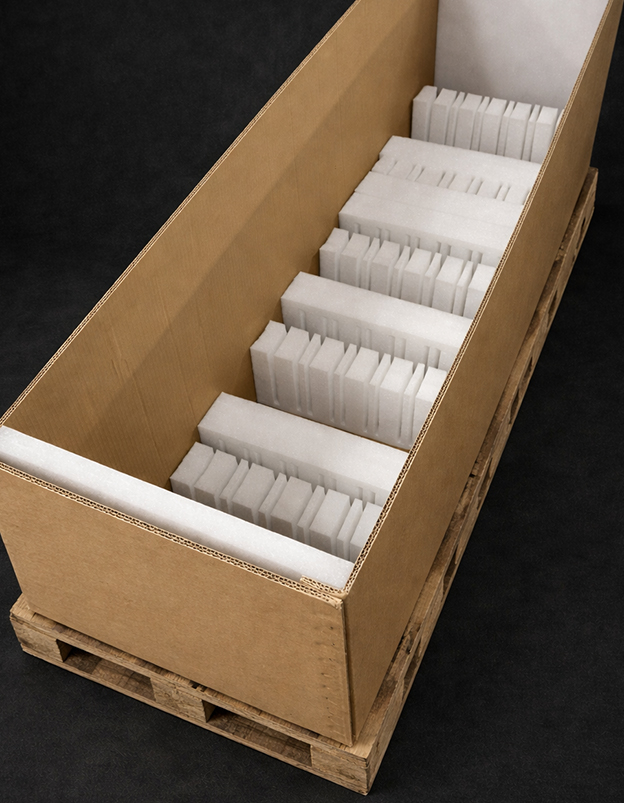
Bespoke foam packaging, forexample, can address this by engineering protection around actual failure points. Electronics need anti-static materials and vibration dampening. Precision instruments require impact-resistant foam cut to support them at optimal stress points. Industrial components need protection from moisture or corrosion. Design packaging services in the UK can assess these requirements and specify materials that prevent damage rather than simply cushioning products in generic foam.
Weight drives shipping costs, particularly for air freight and international shipments. Standard packaging often uses heavier materials than necessary because it's designed for worst-case scenarios across product ranges. Custom packaging design companies optimise material selection for actual requirements.
Bespoke packaging doesn’t mean overbuilt packaging. It means responsibly engineered packaging. A component that requires impact resistance, but not heavy-duty crush protection, is protected using the appropriate material - whether engineered foam or the correct corrugated board grade - avoiding unnecessary weight and excess material. Products requiring minimal protection get packaging that provides exactly that. Every gram removed from packaging weight reduces freight charges.

Optimising packaging materials also helps with sustainability goals without sacrificing product protection. Lighter packaging cuts transport emissions per unit. Design packaging in the UK is built around efficiency rather than off-the-shelf options – this tends to deliver better environmental results at the same time as reducing shipping costs.
Making the switch worthwhile
Shipping costs won't decrease on their own. Carrier rates are likely to carry on climbing, dimensional weight pricing spreads further, and damage rates stay stubbornly high with standard boxes. Companies that assume packaging costs are fixed leave money on the table.
Review your current packaging. Calculate total shipping costs including dimensional weight charges, damage rates and return logistics. Compare those figures against what bespoke packaging manufacturers quote for custom solutions. The business case often becomes obvious once you account for all the expenses standard packaging creates.
At Design Packaging, we work within aerospace, defence, marine, industrial, technology and medical markets supplying bespoke packaging which is designed around lowering shipping costs as well as protecting products. Are shipping costs cutting into your bottomline? Perhaps it's time to rethink your packaging. Contact us and find out how we can help.